
"I strongly believe that words can change the human being itself." I've been thinking about this statement. It struck me when I heard it as a bit counterintuitive but thought-provoking. It countered my intuition because of the context. We had been talking about strong language in general and expletives in particular. The idea that, say, swearing too much could change a person puzzled me. It wasn't something I had thought about previously, but it got me thinking. This post is the first part of my attempt to explain my thoughts.
Back to the original statement: Can words change people? Actually, this statement must be true. I don't think there's any doubt that words at least sometimes constitute actions. The bride who says "I do" at her wedding isn't merely saying those words; she's making a commitment, and she's embracing a set of norms bound up with marriage. She is saying "Yes!" to her husband, and also "I accept this" to the institution of marriage itself. She isn't just saying something; she's doing something. Once we admit that words are, or can be, actions, it's easy to see how words can, and do, change people.
Words change people insofar as people are products of their actions. Some would say that people just are their actions. That overstates things, but it's not far from the truth. We label people "good," "bad," "selfish," "warmhearted," etc. not based on what's in their heart; we apply those labels after we see how people manifest their thoughts and feelings in relation to others. There are no good, bad, selfish, or warmhearted people without a society to provide us with an opportunity to be good, bad, selfish, warmhearted, etc. Society provides an opportunity for people to express the virtues and vices. This is an important point, but it's not the only one. I'll write more on this in Part 2.
Showing posts with label philosophy. Show all posts
Showing posts with label philosophy. Show all posts
Wednesday, July 16, 2008


Monday, July 14, 2008
Qualia, Language, and Butterflies
I believe in something philosophers call qualia. Qualia are, basically, what human experience is like. If a blind person asked you what it's like to see red, you'd be hard-pressed to describe it adequately. Red is something you simply experience. Consider another example: What is it like to taste something? Maybe you think you can answer that question by replying "sweet," "sour," "chewy," "crunchy," etc. And I would say, "Yes, that's correct, but what is the experience of tasting something sweet like? How can you describe it to someone who has never tasted something sweet?" You can't, or at least I don't believe you can, but it exists as a quality of your experience. Lots of people disagree with me, though, and my view might well be in the minority.
Anyway, I believe that there some experiences in life that are simply ineffable. They can't be described properly in words. Qualia are ineffable. So is the feeling in my stomach as I write this. The closest approximation in English is to say that there are butterflies in my stomach. What does that mean? I can't say.
Anyway, I believe that there some experiences in life that are simply ineffable. They can't be described properly in words. Qualia are ineffable. So is the feeling in my stomach as I write this. The closest approximation in English is to say that there are butterflies in my stomach. What does that mean? I can't say.
Thursday, August 30, 2007
Philosophy & Science From A Scientist & A Philosopher
I haven't had much motivation to write lately. Not sure why. I have, however, had plenty motivation to read. Among the books I've been reading are Richard Feynman's The Meaning of It All and Paul Feyerabend's Against Method.
I've read three or four of Feynman's books before. This one is a collection of three lectures on science, religion, and philosophy. The lectures are transcriptions. And it shows; they're not very well written. But there are lots of Feynman's always-interesting anecdotes used to illustrate abstract ideas. I like this argument style a lot--although I can follow abstract arguments, I don't have a lot of faith in them to demonstrate anything important. Only when they're woven together with concrete examples do I really pay attention to the conclusions. Like Feynman, my allegiance lies with empiricism, not rationalism.
The book itself is most interesting for its exposition of science and scientific thinking. The main idea is that there's... not a method, exactly, but a set of values intrinsic to scientific thinking. These values are crucially important for truth-seeking, and they ought to be better respected, but truth-seeking isn't the only important thing in the world. Values themselves, for example, can't be discovered by the scientist. And values, of course, are valuable. Feynman, by his own admission, is not a philosopher, and some of his arguments are dubious, but they're all thought-provoking.
Feyerbend's book is a polemic on the philosophy of science, written by a philosopher. The thesis is interesting: Feyerbend argues for methodological "anarchy" in epistemology and science. The actual evidence to support the thesis isn't very impressive, however. There are too many controversial claims with too few--or zero!--specific citations to back them up. For that reason, it's hard to accept the claims of a philosopher about science over the views of an actual physicist--and a highly respected one at that. But don't take my word for it. Feynman wouldn't want you to.
Sunday, June 10, 2007
RIP
Richard Rorty died yesterday. Rorty was one of the most important and influential philosophers of his generation, not to mention one of the most controversial. His influence reached far beyond the confines of both philosophy and academia. I can't say I agree with all, or even most, of his positions. But Rorty had a radical vision for philosophy--one that, I believe, most philosophers have sadly (and sorely) missed. He, too, will be sorely missed.
Friday, May 18, 2007
By Means Of A Faculty
In his Critique of Pure Reason, Kant asks, "How is synthetic a priori knowledge possible?" Kant's answer? "By means of a faculty." But, unfortunately, not in five words.Fans of Nietzsche might recognize this quotation. It's a caricature of Kant, but it's pithy and clever. Turns out Kant isn't the only one it applies to; we can say just about the same thing about scientists today:
We only showed that brains might possess a faculty which free will could potentially be based on.Actually, unlike Kant, they didn't even show this. Popular science, particularily pop science writing in the mass media, is depressingly terrible, but as a special bonus this article comes chock full of terrible philosophy, too. Almost every paragraph is an irredeemable mess of unfounded assumptions and egregious argumentation. Too bad neither the scientist nor the reporter who wrote the story stuck to a five-word limit.
Wednesday, May 2, 2007
Ethics Is Hard
I began a TEFL (Teaching English as a Foreign Language) Intensive class on Monday. Today we had the opportunity to observe some TESL (Teaching English as a Second Language) classes. (The difference, by the way, is where the class are taught. TEFL classes are taught in non-English countries and TESL classes are taught in English countries). Awesome experience. I loved it. We get to tutor some of these students later, and I absolutely cannot wait. Besides the practical experience, though, we have classroom time, which tends to include lots of exercises. These mainly act to reinforce the theory in our texts. This, too, I find valuable.
Today, we had to match teaching materials with the appropriate skill level. One of the reading materials centered around ethics and moral philosophy. There was a brief description of the subject and some etymology of its terms. Apparently this stuff is tougher than I thought because I underestimated the classification of its difficulty, which was at the highest level; the others were lower, and I guessed all of them correctly. Everyone else, of course, not steeped in moral theory, correctly assessed the difficulty of the ethics material. A little bit of knowledge is a dangerous thing, right? Well, apparently, so is a lot of knowledge.
Today, we had to match teaching materials with the appropriate skill level. One of the reading materials centered around ethics and moral philosophy. There was a brief description of the subject and some etymology of its terms. Apparently this stuff is tougher than I thought because I underestimated the classification of its difficulty, which was at the highest level; the others were lower, and I guessed all of them correctly. Everyone else, of course, not steeped in moral theory, correctly assessed the difficulty of the ethics material. A little bit of knowledge is a dangerous thing, right? Well, apparently, so is a lot of knowledge.
Monday, April 23, 2007
The Road To Hell Is Paved With Good Logicians
Matt Yglesias posted this awhile ago and it stuck with me. Choice excerpt:
The well-intentioned person, being well-intentioned, will try his best to ensure that bad things don't happen. If things that occur as a result of well-intentioned actions are defined as not-so-bad, however, then the well-intentioned person doesn't really need to try his best to ensure that bad things don't happen. After all, the person, being well-intentioned, by definition isn't going to do any very bad things. The things he does, after all, are all well-intentioned things, not bad things.Matt Yglesias graduated magna cum laude with a degree in philosophy from Harvard University. Knowing this, I wasn't surprised to see him make this sort of argument. It's a pragmatic argument for consequentialism; and it's undeniably clever. The whole thing is worth a read.
Wednesday, April 4, 2007
Living With Darwin by Philip Kitcher
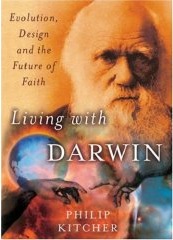
"From the perspective of almost the entire community of natural scientists world-wide, continued resistance to Darwin is absurd." So says Philip Kitcher in his new book, Living With Darwin. This will surprise no one familiar with the state of biology today, yet the politics of evolution are not so simple. No doubt many will disbelieve that the scientific community is as united as Kitcher says it is. After all, what does he know? Here, however, Kitcher stands on firm ground with the support of strong credentials: Kitcher is the John Dewey Professor of Philosophy at Columbia University, and his area of expertise is in the history and philosophy of science. This book is not his first on the debate over evolution, though it assumes no familiarity with his previous work.
Intelligent design is the new challenger to what is now called the neo-Darwinian synthesis, which is Darwinian evolution by natural selection combined with Mendelian genetics. Living With Darwin clarifies and adjudicates the debate between these two camps. Kitcher strongly supports Darwin over intelligent design, and if this is all there was to his book, it would be yet another--if unusually lucid and succinct--exegesis in an already crowded field. But this is not all there is to Kitcher's book.
More seriously, however, books like these are open to the charge of preaching to the choir: The kind of person who will read this book is not the kind of person who needs to read it. Perhaps. But Kitcher avoids these pitfalls as much as possible. Anyone who can read can read Living With Darwin; and few will be turned off by his argument style, which is careful and compassionate, sharply contrasting with people like Richard Dawkins, who Kitcher admits sound harsh and insensitive to thoughtful religious believers.
Against some of his peers, Kitcher argues that intelligent design is science, but it is dead science. On his riveting tour through the history of the debate, Kitcher shows that intelligent design is science in the same way that alchemy is science: Scientists at one time believed in its truth, but those scientists have been shown to be wrong. Accordingly, its only place in schools is in history of science and philosophy classes. But Kitcher adds another indictment: He argues that intelligent design cannot accommodate the kind of claims its adherents would like it to. The people who sell intelligent design, therefore, are rather like intellectual con artists. They know that people want a theory that can support supernatural religious claims, usually belief in the Bible; but they also know that intelligent design cannot offer such support. Their willingness to sell it to these people constitutes an intellectual fraud. Kitcher emphasizes the mendacity of these people, who know that if the public understood the theory, they would realize that it offers no more respite for embattled religious convictions than does belief in Darwinian evolution.
The first four chapters, which total 116 short pages, are a powerful defense of Darwinism against its rivals. But the heart of the book--where it makes its greatest contribution--is the final chapter, which runs to 50 pages. This is where Kitcher deals with the psychological motivations for intelligent design and the future of faith. His observations are unusually insightful but, at the same time, as charitable as possible to religious believers.
Surprisingly, Kitcher agrees with religious opponents to Darwin; evolution is dangerous to faith, or at least to a certain kind of faith. It is dangerous to what he calls "providentialist" faith. This is the religious faith, held by most people, which asserts the existence of a God who intervenes in the world. Evolution chips away at some of the last remaining reasons to believe in this God; and since beliefs require evidence to sustain them, this means that religious belief is in danger. In the story of his own intellectual journey, Kitcher tells us that these considerations motivated him to become an atheist. Though he does not believe that Darwinism necessitates atheism, it does make it more attractive; and it makes almost all forms of religion untenable. The only exception is non-providentialist religion, which eschews supernaturalism altogether. This, however, is not the kind of religion religious people want. They want something or someone to breathe meaning into their lives.
So: religion, for Kitcher, is a crutch, and he supports this with an impressive display of knowledge of the history of Christianity and the Bible. The Enlightenment has steadily eroded reasons to believe in God. Religion remains not because there is good evidence to support it, but largely because it gives life meaning. He quotes William James:
For naturalism, fed on recent cosmological speculations, mankind is in a position similar to that of a set of people living on a frozen lake, surrounded by cliffs over which there is no escape, yet knowing that little by little the ice is melting, and the inevitable day drawing near when the last film of it will disappear, and to be drowned ignominiously will be the human creature's portion. The merrier the skating, the warmer and more sparkling the sun by day, and the ruddier the bonfires at night, the more poignant the sadness with which one must take in the meaning of the total situation.Intelligent design is the last desperate stride of skaters attempting to outrun the cracks in the ice behind them.
But doesn't this completely destroy my claim that Kitcher's book is compassionate, readable by anyone? Surely this amounts to smug superiority, right? Well, Kitcher admits that all of us, atheists included, are stuck on the ice. We all need comfort. Religion provides meaning where other areas of inquiry have failed, including recent philosophy, "which has found little time for larger questions about the meaning and value of human lives." Kitcher again quotes James approvingly:
"The whole function of philosophy ought to be to find out what definite difference it will make to you and me, at definite instants of our life if this world-formula or that world-formula be the true one." Yet if philosophers since James have treated the questions of how "world-formulas" bear on human lives with distaste or disdain, writers and artists have been less fastidious, exploring the possibilities for meaningful life in a world beyond supernaturalism. One way to do philosophy as James conceived it would be to explain and elaborate on literary and artistic insights.Philosophy isn't the only player that needs to change: Kitcher argues that we also need to address the "harsh competitiveness of American life...the vapidity of much secular culture, and above all, the absence of real community." Religion fulfills these roles, and these are its great virtues.
Living With Darwin is as good a book on the subject as anyone could have asked for. It is as sensitive as possible, without being dishonest. It is as lucid and succinct as possible, without being unscholarly or unrigorous. And, as a third way between providentialist religion and Dawkins-style atheism, it is most welcome. I'll close with a quote from the final paragraph of the book:
There is truth in Marx's dictum that religion, more precisely supernaturalist and providentialist religion, is the opium of the people., but the consumption should be seen as medical rather than recreational. The most ardent apostles of science and reason recommend immediate withdrawal of the drug--but they do not acknowledge the pain that would be left unpalliated, pain too intense for their stark atheism to be a viable solution. Genuine medicine is needed, and the proper treatment consists of showing how lives can matter.
Subscribe to:
Posts (Atom)

